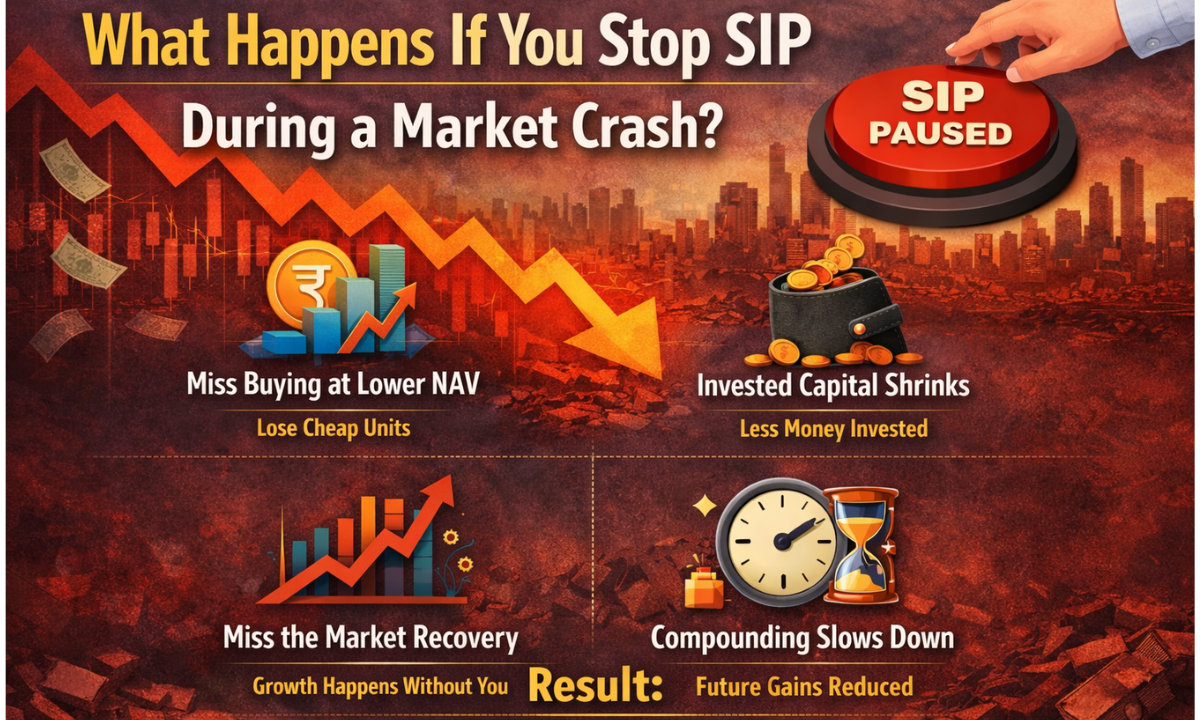
Do you know what happens if you stop SIP during a Market Crash?
When markets fall sharply, it feels uncomfortable to continue investing. Seeing your portfolio in red creates fear and uncertainty. Many investors react by stopping their SIPs, thinking they are protecting their money.
But in reality, stopping a SIP during a market crash can harm long-term wealth creation.
15-Year Data Reveals the Truth
Market corrections and crashes aren’t rare. They’re inevitable. Yet most investors behave like crashes are a surprise — a one-off event. When the market corrects sharply, common reactions include:
- “Markets will fall further — let’s wait.”
- “I’ll restart SIP when things look stable.”
- “Maybe this rally was fake.”
- “What if losses deepen?”
But here’s the real question:
Does stopping your SIP during a crash actually help you? Or does it cost you in the long run?
The answer matters — especially if your goal is wealth creation, not short-term anxiety avoidance. Now let’s dive into the deep, data-based truth backed by 15 years of market experience.
Why Investors Stop SIP During Market Crashes
Before we talk about data and returns, we must understand one powerful factor — human psychology. Investing is not just about numbers. It is about behavior. Human beings are naturally wired to:
✔ Avoid loss
✔ Escape danger
✔ Seek safety and stability
These instincts help in survival, but in investing, they often work against us.
What Happens During a Market Crash?
When markets fall sharply:
- Portfolios turn red
- News becomes negative
- Fear spreads quickly
- Confidence drops
Even long-term investors begin to feel anxious. This is because losses hurt more than gains feel good — a concept known as loss aversion. As the market keeps falling, fear starts overpowering logic. Investors begin to think: “If the market is falling, maybe I should wait for things to stabilize before investing more.”This feels sensible. After all, why invest when prices are going down?
The Emotional Trap
The problem is that markets are unpredictable in the short term but rewarding in the long term. When you stop SIP during a crash:
- You react to fear
- You shift focus from long-term goals to short-term volatility
- You seek emotional comfort instead of a strategic advantage
Markets do not announce when they have stabilized. By the time “calm” returns, prices have often already recovered significantly.
The Core Reason
Investors stop SIP during crashes, not because it is financially wise, but because it feels emotionally safer. However, long-term wealth creation depends on discipline — not comfort. Crashes test patience.SIP rewards consistency.
And history shows that staying invested usually works better than waiting for perfect timing.
What SIP Really Is (And Why It Was Created)
SIP stands for Systematic Investment Plan. At its core, SIP is a simple investing method where:
- You invest a fixed amount
- At regular intervals (usually monthly)
- Regardless of market conditions
It does not require you to predict market highs or lows. It does not depend on economic news. It does not wait for “the right time.”You invest consistently”.And that simplicity is its biggest strength.
Why Was SIP Created?
Financial markets are volatile by nature. Prices move up and down every day due to:
- Economic data
- Corporate earnings
- Global events
- Political changes
- Investor sentiment
For most individual investors, trying to time these movements becomes stressful and often unproductive.SIP was created to address this problem. It removes the burden of decision-making and replaces it with discipline.
The Problems SIP Solves
Let’s understand how this simple method addresses major investing challenges:
1. Market Volatility → Removes Timing Decisions
Market volatility makes investors hesitate. Questions like:
- “Is this the right time?”
- “Should I wait for correction?”
- “What if markets fall after I invest?”
These doubts delay action.SIP eliminates this uncertainty. Since investments happen automatically at fixed intervals, there is no need to time the market. You invest in both rising and falling markets.
2. Emotional Bias → Regularizes Investing Behavior
Investors are influenced by emotions:
- Fear during crashes
- Greed during bull runs
- Anxiety during uncertainty
These emotions often lead to poor decisions — buying high and stopping at lows.SIP brings structure to investing. It converts investing into a habit rather than a reaction. Instead of asking “Should I invest this month?” the question disappears — because the investment happens automatically.
3. High Valuations → Rupee Cost Averaging
When markets are expensive, SIP continues investing. Since prices are high, your fixed amount buys fewer units. This protects you from investing a large lump sum at peak valuations.
4. Low Valuations → Higher Unit Accumulation
When markets fall, SIP becomes even more powerful. Because prices are lower, the same fixed amount buys more units. Over time, this reduces the average cost of investment — a concept known as rupee cost averaging.This is how volatility becomes an advantage instead of a threat.
SIP Is More Than a Tool
Many people think SIP is just a payment method. It is not.It is a behavior-management framework built specifically for the ups and downs of the market.It:
- Reduces emotional mistakes
- Encourages long-term thinking
- Automates discipline
- Converts volatility into opportunity
Markets will always fluctuate. That is their nature.SIP was designed to function effectively because markets fluctuate, not despite it.
The Bigger Perspective
Successful investing is less about predicting markets and more about controlling behavior.SIP helps you control the only thing you truly can — your own consistency. In the long run, discipline often matters more than timing. And that is exactly why SIP was created.
The 15-Year Market Reality
To truly understand why stopping SIP during crashes can be costly, we need to step back and look at how markets have actually behaved over a meaningful period.
Let’s examine the Indian equity market from roughly 2009 to 2024 — a 15-year period that includes multiple crises, sharp corrections, strong bull runs, and long phases of uncertainty.
If you look at benchmark indices like the Nifty 50 and S&P BSE Sensex during this time, one thing becomes clear:
The journey was volatile.But the long-term direction was upward.Let’s break this period into phases.
2009: Recovery After the Global Financial Crisis
In 2008, global markets collapsed due to the financial crisis triggered by the US housing bubble. By early 2009, Indian markets were deeply corrected. Fear was widespread. Many investors had exited equity. But from those lows, markets began a strong recovery. Investors who stayed invested — or continued SIP — participated in one of the sharpest rebounds in history.
Lesson: Recoveries often begin when sentiment is still negative.
2011: European Debt Crisis
Just when confidence was returning, the European debt crisis created global uncertainty. Markets corrected again. Volatility increased. Headlines predicted a prolonged slowdown. Investors who had just regained confidence faced another test.Markets moved sideways and corrected in phases.But again, this phase eventually passed.
2013: The “Taper Tantrum”
In 2013, the US Federal Reserve signaled a reduction in stimulus. Emerging markets, including India, saw heavy selling. The rupee depreciated sharply. Fear resurfaced. Short-term investors panicked. Long-term investors continued. Markets stabilized and resumed their upward trend.
2016: Demonetization Shock
The sudden demonetization announcement created economic uncertainty. There were concerns about growth, liquidity, and consumption. Markets reacted negatively in the short term. But within months, stability returned, and long-term growth drivers remained intact. Again — temporary disruption, not permanent destruction.
2018–2019: Liquidity Crisis
The IL&FS default triggered a liquidity crunch in the financial system. NBFC stocks corrected heavily. Market volatility increased. Investor confidence weakened.Yet, over time, businesses adjusted and markets moved forward.
2020: The COVID Crash (~35–40% Fall)
This was one of the most dramatic market events in modern history.In a matter of weeks:
- Markets fell around 35–40%
- Economic activity stopped
- Lockdowns were imposed
- Uncertainty was at its peak
It felt like the world was ending. Many investors stopped SIPs. Some redeemed investments entirely.But what happened next surprised almost everyone. Within months, markets began recovering. Over the next year, indices reached new highs.Those who continued investing during the panic accumulated units at historically low valuations.
2021–2024: Post-COVID Rally and Volatility
The post-pandemic period saw:
- Massive liquidity-driven rally
- Retail investor participation surges
- New all-time highs
- Followed by inflation concerns, rate hikes, and global uncertainty
Markets didn’t move in a straight line. There were corrections and sharp recoveries. But over the full 15-year period, the broader trend remained positive.
The Cost of Stopping SIP: A Numerical Comparison
Understanding psychology is important. Understanding market history is important. But nothing explains the impact better than numbers. Let’s do a practical comparison between two disciplined investors — both with the same income, same goals, and same investment product.
The only difference? One continues SIP during a crash. The other pauses SIP during the crash.
The Setup: Common Assumptions
To make this realistic, let’s assume:
✔ SIP Amount: ₹10,000 per month
✔ Investment Duration: 15 years
✔ Total Monthly Investments: 180 installments
✔ Investment Type: Diversified Indian equity mutual fund
✔ Expected Long-Term Return: 12–14% CAGR (historical broad equity range)
If invested without interruption for 15 years:
Total Contribution = ₹10,000 × 12 × 15
= ₹18,00,000
Now let’s compare the two investors.
Scenario A: Investor A Continues SIP Without Stopping
Investor A understands that volatility is part of investing. Even during crashes, corrections, and scary headlines, he continues investing every month.
Results After 15 Years:
Total Invested: ₹18,00,000
Estimated Final Corpus: ₹45–₹55 lakh
(Assuming 12–14% annualized returns; actual returns vary by start date and fund performance.)
What helped Investor A?
- He bought during bull markets.
- He bought during bear markets.
- He accumulated more units during crashes.
- He allowed compounding to work uninterrupted.
He did nothing extraordinary. He stayed consistent.
Scenario B: Investor B Stops SIP for 12 Months During a Crash
Investor B starts SIP with good intentions.However, during a major market correction (for example, a 30–40% fall), he becomes uncomfortable and pauses his SIP for one year.He resumes after the markets stabilize.Let’s see the impact.
Revised Investment:
Instead of 180 installments, he invests only 168 installments.
₹10,000 × 12 × 14 years
= ₹16,80,000
So, his invested capital immediately reduces by ₹1,20,000.But the real cost is not just the missing ₹1,20,000.The real cost is missing the lowest NAV purchases during the crash year.
Results After 15 Years:
Total Invested: ₹16,80,000
Estimated Final Corpus: ₹40–₹47 lakh
The Real Difference
Difference in Final Corpus: ₹4–₹8 lakh or even more, and this is from just one 12-month pause. Imagine if an investor pauses multiple times across 15 years.The wealth gap widens further.
Why Is the Difference So Large?
At first glance, the difference may seem surprising. After all, ₹1,20,000 is only about 6–7% of the total planned investment.But the final wealth gap can be much larger than 6–7%.Why?Because:
1️⃣ Missed Units at Lowest Prices
Crash periods allow investors to buy more units at lower NAVs.When you stop SIP during a crash, you miss:
- Maximum unit accumulation
- Discounted entry levels
- Future compounding on those extra units
Those missed units would have multiplied significantly during recovery.
2️⃣ Missed Recovery Gains
Historically, the strongest market gains often come soon after deep corrections. If you pause during the fall and restart after recovery begins, you miss the fastest appreciation phase. That lost compounding can never be recovered later.
3️⃣ Compounding Impact Multiplies Over Time
Compounding works like a snowball. Money invested earlier has more time to grow. The SIP installments skipped during the crash year had the potential to compound for the remaining years. Missing one year early in the journey hurts much more than missing one year at the end.
A Small Pause, A Big Impact
Many investors think: “It’s just one year. What difference will it make?”But long-term investing magnifies small decisions. A short emotional reaction today can reduce wealth years later. The numbers clearly show: Stopping SIP does not protect wealth. It reduces wealth-building potential.
The Core Lesson
Both investors started with the same plan. Both had the same resources. Both invested in the same type of fund. The only difference was discipline during a difficult year. And that one behavioral difference created a gap of several lakhs. That is the direct financial impact of pausing SIP during a crash — even when the pause is temporary.
The Big Truth: Markets Don’t Fall Forever
One of the biggest fears investors face during a market crash is the feeling that “this time is different” — that markets may never recover. But if we step back and study history objectively, one truth becomes very clear: Markets do not fall forever. Short-term declines are normal. Long-term growth is consistent.
Over decades of market history — both globally and in India — we repeatedly see the same pattern:
✔ Bear markets eventually end
✔ Corrections reverse
✔ New highs follow major lows
✔ Long-term trends remain upward
The journey is volatile. The direction, over time, has been growth.
Understanding Market Cycles
Markets move in cycles. There are periods of optimism and strong growth. There are periods of slowdown and correction. There are phases of panic and uncertainty. But these phases are temporary. Economic systems are dynamic. Businesses adapt. Policies change. Innovation continues. The population grows. Consumption increases. Productivity improves. Equity markets reflect long-term economic progress — not short-term fear.
Historical Examples That Prove the Point
Let’s look at two powerful examples that many investors still remember.
2008 Global Financial Crisis
In 2008, global markets collapsed due to a severe financial crisis. In India, benchmark indices fell roughly 50–60% from peak to bottom. Investor confidence was shattered. News headlines predicted long recessions. Many believed recovery would take a decade. But what happened? Markets bottomed out in 2009 . Within about two years, indices had largely recovered. In the years that followed, markets went on to create new highs. Investors who stopped investing during the crash missed the recovery phase.
Investors who continued their SIP during that period accumulated units at historically low prices — and benefited significantly when the rebound happened.
2020 COVID Crash
The COVID crash was even more dramatic in terms of speed.In early 2020, markets fell around 35% in a matter of weeks. Lockdowns were imposed. Economic activity halted. Fear was global.It felt unprecedented. Many investors paused their SIPs or exited completely. But recovery began much sooner than expected. Within months, markets started rising. Over the next year, indices reached new highs. Those who continued investing during the panic period bought at extremely attractive valuations.Those who stopped investing had to re-enter at much higher levels.
Why Markets Eventually Recover
There are fundamental reasons why markets do not fall forever:
- Businesses continue to operate and generate profits.
- Economies grow over long periods.
- Inflation pushes nominal growth upward.
- Innovation and productivity improve earnings.
- Policymakers intervene during crises to stabilize systems.
Temporary shocks create volatility. Structural growth drives long-term returns. That is why, historically, every major crash has eventually been followed by recovery and new highs.
Why Crash Periods Are Actually Valuable
Here is the critical insight: The period when markets are falling is often the most valuable accumulation phase for long-term investors. When markets decline:
- NAVs become cheaper
- Valuations improve
- Future return potential increases
If you continue SIP during this phase, your fixed investment buys more units. When recovery comes — and history shows it usually does — those additional units multiply in value. But if you stop SIP during a crash, You reduce investment exactly when opportunities are greatest. You invest less during the most valuable purchasing period — when NAVs are cheapest.
That is the hidden cost of reacting emotionally.
The Bigger Perspective
Crashes feel permanent when you are inside them. But when you zoom out over 10–15 years, they appear as temporary dips in a long upward journey.The key is perspective.Markets don’t fall forever.Fear doesn’t last forever .But missed opportunities during low prices cannot be recovered later.And that is why continuing SIP during crashes has historically rewarded disciplined investors.
The Psychological Side of Investing
Investing is less about intelligence and more about behavior. Markets do not test how smart you are — they test how patient you are. When markets rise, confidence is high. But when markets fall, emotions take control.During a downturn:
🔸 Losses feel personal
🔸 Headlines become scary
🔸 Social media amplifies fear
🔸 Confidence drops
Even experienced investors feel uncomfortable seeing their portfolio in the red. This happens because losses hurt more than gains feel good — a concept known as loss aversion.
Why Fear Leads to Mistakes
In a crash, investors feel the need to “do something.”Stopping SIP creates a false sense of control. But there’s a difference between strategic decisions and emotional reactions. Strategic decisions are based on long-term goals . Emotional decisions are based on short-term fear.
Stopping SIP during a crash is usually emotional — not strategic.
The Power of Staying Consistent
Long-term investing works because it removes emotion from the process.
SIP ensures you invest:
- When markets are high
- When markets are low
- Without trying to time the market
The key principle is simple: Money decisions should be based on logic — not fear. Market declines are temporary. But decisions made out of fear can impact long-term wealth. Successful investing is not about avoiding volatility —It is about staying disciplined during it.
The Big Mistake: Missing Recovery Months
Here’s a critical truth that many investors underestimate:
The best market returns often come immediately after the worst months.
When markets crash, fear dominates. Investors expect further decline. Many stop investing or move to the sidelines, waiting for “stability” before restarting. But history shows something very important:
📌 The biggest positive months often occur soon after major crashes.
📌 A large portion of total long-term returns comes from a small number of strong recovery months.
📌 Missing just a few of these months can significantly reduce overall wealth creation.
Why Recovery Happens So Fast
Market declines are usually sharp and emotional. Prices fall quickly due to panic, uncertainty, and forced selling.But recoveries are often faster than expected. Why?
- Valuations become attractive.
- Long-term investors start buying.
- Institutions deploy capital.
- Policy measures support the economy.
- Sentiment shifts rapidly from extreme fear to cautious optimism.
- When confidence begins to return, prices can rise aggressively — sometimes within weeks.
By the time “clarity” appears in headlines, much of the recovery has already happened.
What Typically Happens
Let’s understand the common pattern:
| Period | Market Behavior |
|---|---|
| Crash | Prices fall sharply due to panic |
| Early Post-Crash | Strong rebound begins unexpectedly |
| Waiting Phase | Investors delay restarting SIP, waiting for stability |
| Result | Major recovery gains are missed |
The irony is this:
Investors stop investing when prices are low. They restart when prices are higher, and confidence feels safer . Emotionally, it feels logical. Financially, it is costly.
The Cost of Missing the Best Months
Long-term wealth creation in equity markets is not linear. Returns are uneven. A small number of powerful months often contribute disproportionately to total returns. If an investor stays invested continuously, they automatically capture those months. But if they pause investments during crashes — or wait for the “perfect entry” — they risk missing the strongest rebound phase. Even missing a handful of top-performing months over a decade can dramatically reduce final portfolio value.
The Myth of Perfect Timing
Many investors believe:
“I’ll restart once markets stabilize.”
“I’ll wait for confirmation that the bottom is formed.”
“I’ll invest when things look clearer.”
The problem is:
By the time things look clear, markets have usually already moved up. Timing the exact bottom is nearly impossible — even for professionals. The market does not ring a bell at the lowest point.
The Real Lesson
Trying to time the bottom often leads to missing the recovery. And missing the recovery is one of the biggest long-term investing mistakes. Consistency captures rebounds automatically. Pausing investments risks missing them.
That is why disciplined investing — especially continuing SIP during volatility — protects you from the costliest mistake of all: Being absent when the market rises the fastest.
A Better Strategy During Market Crashes
Market crashes feel uncomfortable — but they do not require panic.Instead of stopping your SIP, a smarter approach is to stay disciplined and strategic.Here’s what you can do:
Continue SIP Without Interruption
Even if markets look scary, continue your SIP.
Crashes are temporary phases. By staying invested, you automatically buy at lower prices and position yourself for recovery. Consistency is your biggest advantage.
Increase SIP (If Cash Flow Allows)
If your income is stable and you have surplus funds, consider increasing your SIP.Lower prices mean you accumulate more units for the same amount. When markets recover, those additional units can significantly boost returns.
Think of it as buying quality assets at a discount.
Rebalance Your Portfolio
Market crashes often disturb your asset allocation.For example, equity may fall below your target allocation. Rebalancing helps you restore the original mix of equity and debt based on your goals and risk profile.
This ensures your portfolio stays aligned with your long-term plan — not short-term volatility.
Avoid Daily Market Tracking
Constantly checking market movements increases anxiety. Short-term fluctuations do not matter for long-term financial goals. Checking your portfolio every day can trigger emotional decisions. Reduce noise. Focus on strategy.
Focus on Long-Term Goals, Not Volatility
Your financial goals — retirement, child’s education, wealth creation — are long-term in nature. Markets move in cycles. Goals require patience.
Remember:
Wealth creation takes time — not timing.
Staying consistent during crashes often makes the biggest difference in long-term success.
You may also like: Start Early,Retire Happy